When executives think about cybersecurity threats, the mental image is often the same: a shadowy hacker in a foreign country probing the perimeter, looking for a crack in the firewall. But the reality facing most organizations today is far less cinematic and far more uncomfortable.
The threat is often already inside.
According to Verizon’s Data Breach Investigations Report, insider threats — whether malicious, negligent, or compromised — account for a significant portion of confirmed data breaches year after year. Yet the overwhelming majority of enterprise security budgets remain focused outward. Organizations spend millions hardening the walls while leaving the doors wide open.
This is not a technology failure. It is a strategy failure. And it begins with how organizations think about identity.
What Is an Insider Threat, Really?
An insider threat is not simply a disgruntled employee stealing files on their way out the door. The category is broader — and more nuanced — than most leaders realize.
- Malicious insiders are individuals who intentionally abuse their access privileges for personal gain, sabotage, or espionage. These are the cases that make headlines.
- Negligent insiders are employees, contractors, or partners who inadvertently expose sensitive data through careless behavior, such as reusing weak passwords, clicking phishing links, or oversharing files via cloud tools.
- Compromised insiders are the most dangerous and least visible category. These are legitimate users whose credentials have been stolen or manipulated by external actors. The attacker walks in through the front door using a valid identity.
What all three have in common is access — specifically, access that exists beyond what is necessary, monitored, or governed. And that is precisely where Workforce Identity and Access Management (IAM) steps in.
Why Traditional Security Fails Against Insider Threats
Legacy security models were built on a simple premise: if you are inside the network, you can be trusted. That premise is now obsolete. The modern enterprise does not have a perimeter in any meaningful sense. Users are remote. Applications live in the cloud. Third-party vendors connect directly to internal systems. The attack surface is no longer a wall; it is a vast, distributed web of identities, devices, and access points. In this environment, traditional tools like firewalls and endpoint protection are necessary but nowhere near sufficient. They cannot answer the most important question in modern security:
Should this person, at this moment, have access to this resource?
That question can only be answered by a robust identity architecture, and most organizations lack one.
The IAM Imperative: Access as a Security Control
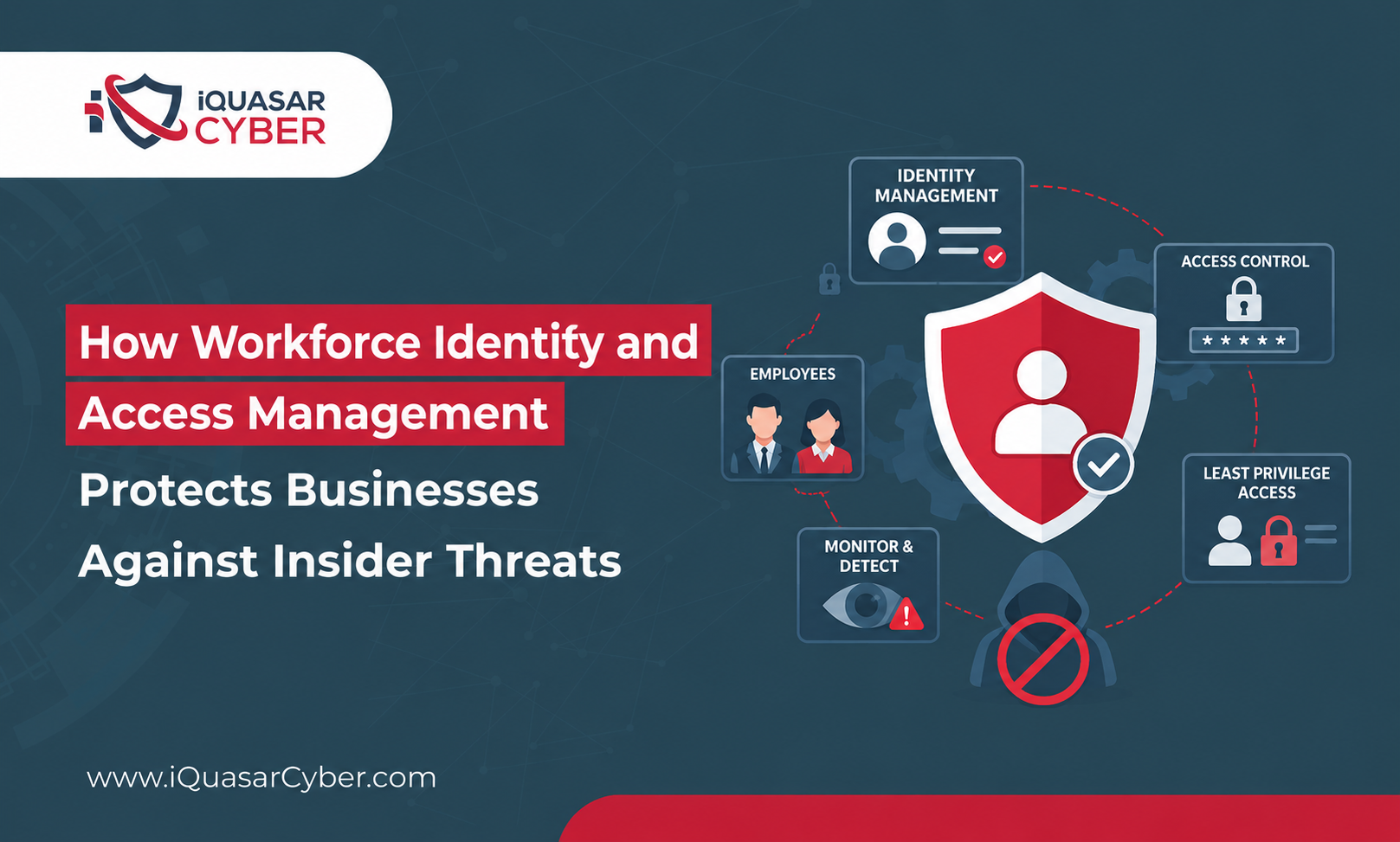
Workforce IAM is not an IT helpdesk function. For executives who understand the threat landscape, it is a first-order security control — one that directly reduces both the likelihood and the blast radius of an insider incident.
Here is what a mature Workforce IAM program delivers:
Least-Privilege Access.
Users receive only the permissions they need to perform their job — nothing more. This is not just a security principle; it is an operational philosophy. When access is scoped correctly, the damage an insider can do — whether through malice or mistake — is fundamentally constrained.
Role-Based Access Control (RBAC).
Access rights are assigned to roles, not individuals. When someone joins, changes roles, or leaves the organization, their access is automatically updated. There are no orphaned accounts, no lingering permissions, no forgotten contractor credentials from three years ago.
Privileged Access Management (PAM).
The most sensitive systems — financial platforms, customer data repositories, infrastructure controls — require elevated access. PAM ensures that privileged access is granted just-in-time, fully logged, and subject to additional authentication. An attacker who compromises a standard account cannot simply escalate to admin rights.
User Behavior Analytics (UBA).
IAM is not just about provisioning access; it is about monitoring how that access is used. Anomalous behavior — an employee accessing systems they never touch, downloading unusually large volumes of data, logging in at 2 a.m. from an unrecognized location — triggers automated alerts before the damage is done.
Single Sign-On (SSO) and Multi-Factor Authentication (MFA).
These controls reduce the attack surface for credential theft. SSO eliminates password sprawl. MFA ensures that even if a password is compromised, it alone is insufficient to grant access.
Automated Deprovisioning.
The most overlooked risk in many organizations is the offboarded employee whose accounts remain active for weeks or months. Automated deprovisioning, triggered by HR system events, eliminates this vulnerability entirely.
The Business Case: This Is Not Just About Security
For executives weighing investment decisions, Workforce IAM is not a cost center — it is a risk-reduction asset with a measurable return.
Regulatory compliance.
HIPAA, SOC 2, CMMC, FedRAMP, and a growing list of frameworks explicitly require identity controls. A mature IAM program does not just protect you from breaches; it protects you from the fines, audits, and contract losses that follow them.
Operational efficiency.
Manual access provisioning is slow, error-prone, and expensive. Automated IAM reduces the administrative burden on IT teams, accelerates employee onboarding, and eliminates help desk tickets for password resets — which represent a surprisingly large share of IT labor costs.
Third-party risk management.
Vendors, contractors, and partners introduce access risk that most organizations do not adequately govern. A mature IAM program extends identity controls across the ecosystem, not just to direct employees.
Cyber insurance.
Insurers are increasingly requiring evidence of identity controls as a condition of coverage. Organizations without MFA, PAM, or identity governance programs are seeing premiums rise — or policies denied outright.
What Leaders Get Wrong
The most common executive misconception about IAM is that it is a one-time deployment. “We bought a tool. We are covered.”
Identity is not a product. It is a program. It requires governance frameworks, ongoing policy review, integration with HR and IT operations, and continuous monitoring. Organizations that treat IAM as a checkbox — deploying a solution and walking away — tend to discover its limitations the hard way.
The second misconception is that insider threats are exclusively a human resources problem. Security culture matters enormously, but it cannot substitute for technical controls. The negligent employee who clicks a phishing link will not be corrected by policy training alone. The architectural controls that limit what happens when they do click are what contain the incident.
A Framework for Executive Action
If you are a CISO, CTO, or CEO assessing your organization’s insider threat posture, begin with these questions:
- Do you know, at this moment, who has access to your most sensitive systems — and whether that access is still appropriate?
- What happens when an employee is terminated? How long before their access is revoked?
- Can you detect anomalous access behavior in real time, or only after the fact?
- Are your third-party vendors governed under the same identity policies as your employees?
- When did you last audit privileged accounts — and were there any surprises?
If the honest answer to any of these is “I don’t know,” that is where the conversation with your security leadership needs to start.
iQuasar Cyber: Your Workforce IAM Partner
At iQuasar Cyber, we have spent over a decade building identity and access management programs for organizations that cannot afford to get security wrong — including healthcare institutions, banking and financial services firms, and government contractors operating under the stringent requirements of CMMC 2.0.
Our IAM solutions are not off-the-shelf implementations. We begin with a deep assessment of your current identity posture, identify the gaps that create real exposure, and design a governance framework tailored to your organization’s size, complexity, and regulatory obligations. From role-based access design and privileged access management to user behavior analytics and automated provisioning, we deliver the architecture, expertise, and ongoing management your program requires.
We partner with industry-leading platforms — including One Identity — to ensure your IAM infrastructure is built on proven, enterprise-grade technology. And for defense contractors and government-adjacent organizations, our CMMC 2.0 advisory services ensure your identity controls meet federal requirements without disrupting operations.
Your identity architecture is the foundation of your security posture. iQuasar Cyber is here to ensure the foundation is solid.