Every CISO’s nightmare used to be the outside attacker: the ransomware gang, the nation-state actor, the criminal syndicate probing the perimeter. Today, a growing share of breaches start much closer to home. The employee with excessive access. The contractor whose credentials were never revoked. The well-meaning staff member who clicks the wrong link and hands an attacker a legitimate login.
Insider threats, whether malicious, negligent, or the result of compromised credentials, now rank among the costliest and hardest-to-detect risks facing organizations in healthcare, banking, and government. The uncomfortable truth for executives: your firewalls, endpoint tools, and network monitoring were built to stop threats coming in. They were never designed to stop someone who’s already inside.
That’s where Workforce Identity and Access Management (IAM) becomes not just an IT control, but a boardroom-level defense strategy.
The Insider Threat Problem Is Bigger Than “The Bad Apple”
When executives hear “insider threat,” they instinctively picture a disgruntled employee stealing data on the way out the door. That scenario exists, but it’s the minority case. Most insider incidents fall into three categories:
- Negligent insiders: employees who misconfigure permissions, share credentials, or fall for phishing, opening the door without ever intending harm.
- Compromised insiders: legitimate accounts hijacked by external attackers who then operate with the full trust and access level of a real employee.
- Malicious insiders: the smaller but highest-impact group, deliberately misusing access for financial gain, retaliation, or espionage.
In every one of these cases, the common denominator is the same: access. An insider threat can only do damage in proportion to what that identity is allowed to touch. This is precisely why identity, not the network edge, has become the real security perimeter.
Why Traditional Security Tools Fall Short
Perimeter defenses, antivirus, and network segmentation all assume the threat is external. But an employee logging in with valid credentials, at a normal hour, from a normal device, doesn’t trip most alarms. They don’t need to “break in”; they’re already authorized.
Without strong identity governance, organizations accumulate what’s often called access sprawl: employees who changed roles but kept their old permissions, contractors whose accounts were never disabled, and administrators with far broader privileges than their jobs require. Every one of these is a standing liability, waiting for the wrong moment, whether a phishing email, a moment of frustration, or a simple mistake, to become an incident.
How Workforce IAM Closes the Gap
A mature Workforce IAM program directly addresses each of these failure points, and does so in ways that matter as much to the boardroom as to the security operations center.
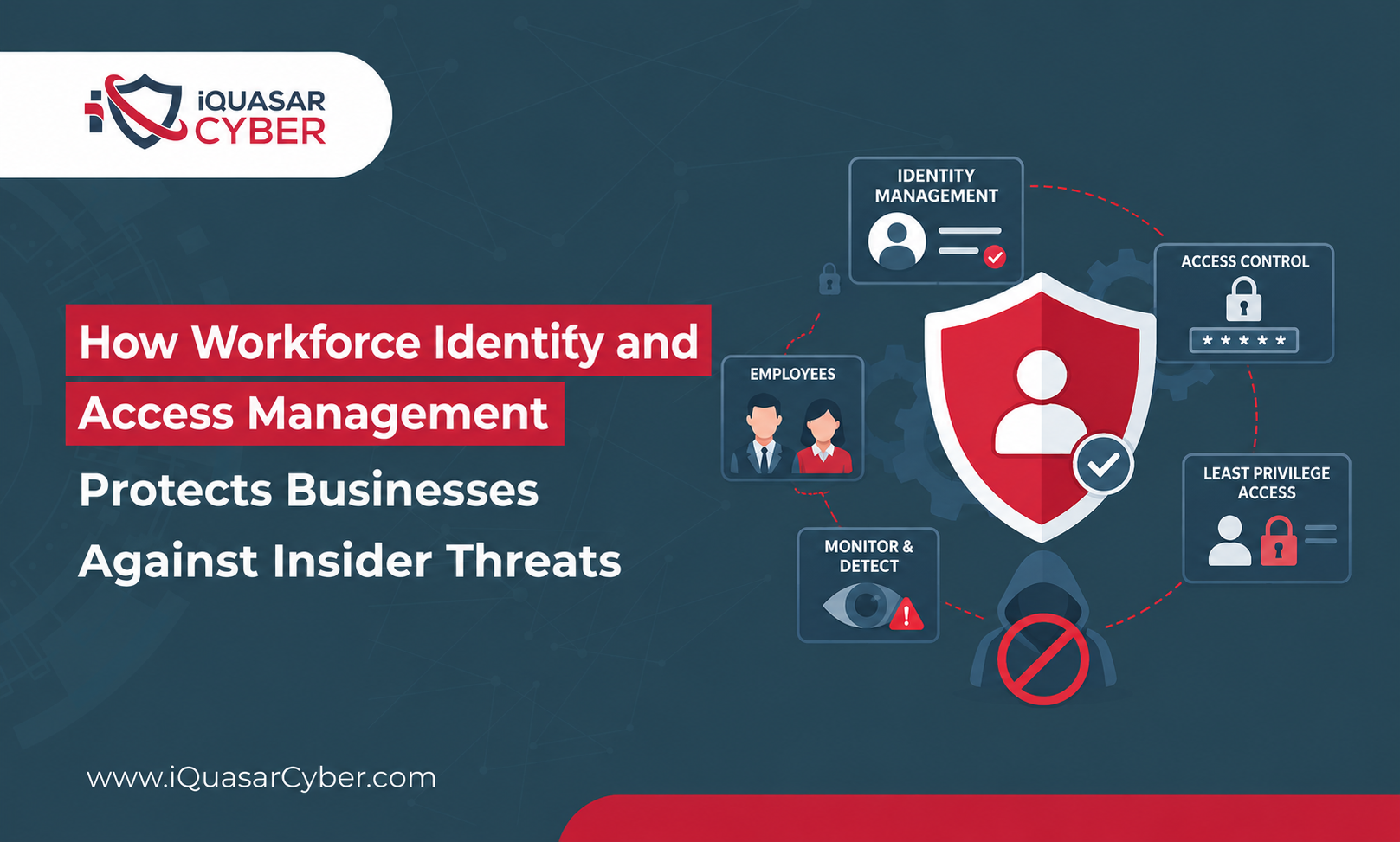
1. Least-privilege access, enforced continuously:
Role-based access ensures employees have exactly the access their job requires, no more, no less. Combined with day-one, automated provisioning, new hires and role changes get the right access immediately, without the manual delays that often lead to over-provisioning “just in case.”
2. Centralized visibility and control:
A unified control point for authentication, authorization, and user access means security teams don’t have to chase permissions across dozens of disconnected systems. When access lives in one governed system, unauthorized or unusual access patterns are far easier to spot and far harder to hide.
3. Behavioral analytics that catch what rules miss:
Insider threats rarely announce themselves. User behavior analytics that merge access rights with actual usage data enable security teams to spot anomalies, such as a finance employee suddenly accessing HR systems or a login pattern that doesn’t match a person’s normal routine, before they become headlines.
4. Faster, cleaner offboarding:
One of the most common, and preventable, sources of insider risk is the former employee or contractor whose access was never fully revoked. Centralized IAM ensures deprovisioning happens immediately and completely, closing a gap that manual processes routinely miss.
5. Compliance as a byproduct, not a burden:
For organizations in healthcare, banking, and government, insider threat controls aren’t optional; they’re a regulatory expectation. A well-architected IAM program builds the audit trails and access governance that HIPAA, financial services regulations, and frameworks like CMMC 2.0 require, turning a compliance obligation into an operational strength.
The Executive Case: Risk Reduction Meets Business Value
For executives weighing where to invest security dollars, Workforce IAM offers something rare: a control that reduces risk and improves the business simultaneously.
- Lower breach costs. Limiting what any single identity can access reduces the blast radius when something goes wrong.
- Reduced administrative overhead. Centralized identity management eliminates redundant accounts and manual access reviews, cutting operational cost.
- Better user experience. Streamlined logins and Single Sign-On mean employees spend less time fighting passwords and more time working, without sacrificing security.
- Audit-readiness on demand. When regulators or clients ask “who has access to what, and why,” a mature IAM program has the answer in minutes, not weeks.
Insider threats will never be fully eliminated; people will always make mistakes, and credentials will always be a target. But the organizations that fare best aren’t the ones that eliminate all risk; they’re the ones that make sure no single identity, if compromised or misused, can cause outsized damage.
Where iQuasar Cyber Fits In
At iQuasar Cyber, we help organizations in healthcare, banking, and government build IAM programs that do exactly this: secure business processes, automate access governance, and give leadership the visibility they need to trust their own systems. Backed by more than a decade of experience, including work with Fortune 50 clients, our approach pairs centralized identity management with the compliance rigor these industries demand, including support for CMMC 2.0 readiness.
Insider risk isn’t going away. The question for executives isn’t whether your organization will face an insider threat; it’s whether, when it happens, your access controls contain it or amplify it.
Ready to assess your organization’s exposure to insider risk? Connect with iQuasar Cyber to talk through your IAM strategy.