
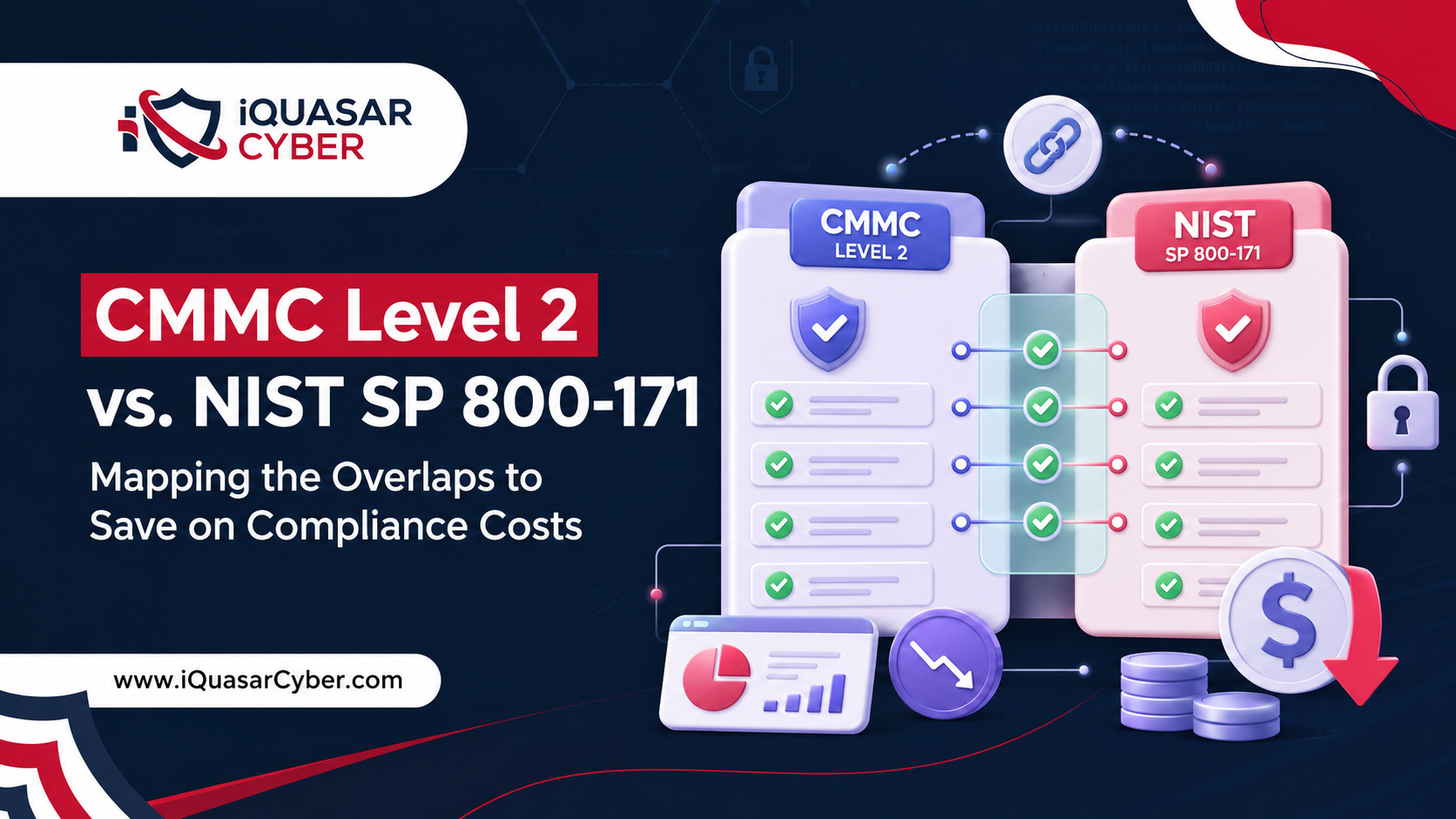
For defense contractors, few compliance questions generate more confusion in the boardroom than this one: “We already comply with NIST SP 800-171 — why are we being told we also need CMMC Level 2?” The short answer: you don’t need two separate compliance programs. CMMC Level 2 and NIST SP 800-171 aren’t competing frameworks — they are, for all practical purposes, the same 110 security requirements viewed through two different lenses. One tells you what to implement. The other tells the Department of Defense (DoD) how it will know you did it.
Understanding that distinction — and where the frameworks genuinely diverge — is the difference between running two redundant, budget-draining compliance efforts and running one lean program that satisfies both. For CFOs, CISOs, and program leaders bidding on DoD work, that distinction is worth real money.
The Core Relationship: One Standard, Two Purposes
NIST SP 800-171 is a technical publication from the National Institute of Standards and Technology. It defines 110 security requirements, organized into 14 control families, that any organization handling Controlled Unclassified Information (CUI) must implement. It has governed defense contractors since DFARS clause 252.204-7012 made it mandatory years ago — historically through self-attestation.
CMMC (Cybersecurity Maturity Model Certification) Level 2 is the DoD’s verification layer on top of that same standard. Rather than inventing new controls, CMMC Level 2 was built to certify — through self-assessment or third-party review — that a contractor has actually implemented the 110 requirements in NIST SP 800-171 Rev. 2, evaluated against 320 specific assessment objectives.
Put simply: NIST SP 800-171 is the what. CMMC Level 2 is the proof.
This is why, structurally, there is no meaningful gap to close between the two at Level 2. If your organization has fully implemented NIST SP 800-171, you are already positioned for CMMC Level 2. If you’re compliant with CMMC Level 2, you are, by definition, compliant with NIST SP 800-171.
Where the Two Frameworks Diverge
The overlap is close to total, but three differences matter for planning:
1. Verification mechanism. NIST SP 800-171 compliance was historically self-attested, with organizations scoring themselves and submitting results to the Supplier Performance Risk System (SPRS). CMMC introduces structured assessment — either a rigorous self-assessment or, for higher-risk contracts, evaluation by a Certified Third-Party Assessment Organization (C3PAO).
2. Regulatory teeth. DFARS 252.204-7012 mandates NIST SP 800-171 implementation. DFARS 252.204-7021, finalized in November 2025, is what actually makes CMMC certification a condition of contract award. Failing to meet either exposes contractors to False Claims Act liability, not just a failed audit.
3. Where things stand right now. This is the detail many compliance vendors gloss over, and it matters for budgeting decisions made today. On July 13, 2026, the Department of War suspended all pending milestones in the CMMC phased rollout — including the mandatory third-party (C3PAO) assessment track — pending a program review focused partly on reducing burden for small and mid-sized contractors. During this review, contracting officers can only designate Level 1 (Self) or Level 2 (Self); third-party Level 2 certification is paused, not eliminated. Critically, the underlying obligations have not changed: DFARS 252.204-7012, the 110 NIST SP 800-171 requirements, and SPRS reporting all remain fully in effect. The requirements didn’t move. Only the audit mechanism did — temporarily.
For contractors, that means the smart move is to keep building toward the full control set regardless of which verification path eventually resumes.
Mapping the Overlap: NIST SP 800-171’s 14 Control Families
Every one of the 14 control families in NIST SP 800-171 Rev. 2 maps one-to-one into CMMC Level 2’s domains. There is no separate CMMC control library to learn.
| NIST SP 800-171 Control Family | CMMC Level 2 Domain | Compliance Focus |
|---|---|---|
| Access Control (AC) | Access Control (AC) | Who can reach CUI, and under what conditions |
| Awareness & Training (AT) | Awareness & Training (AT) | Security literacy across the workforce |
| Audit & Accountability (AU) | Audit & Accountability (AU) | Logging, monitoring, traceability of user actions |
| Configuration Management (CM) | Configuration Management (CM) | Baseline, hardened system configurations |
| Identification & Authentication (IA) | Identification & Authentication (IA) | Verifying user and device identity |
| Incident Response (IR) | Incident Response (IR) | Detection, reporting, and recovery processes |
| Maintenance (MA) | Maintenance (MA) | Controlled system maintenance activities |
| Media Protection (MP) | Media Protection (MP) | Safeguarding CUI on physical and digital media |
| Personnel Security (PS) | Personnel Security (PS) | Screening and offboarding procedures |
| Physical Protection (PE) | Physical Protection (PE) | Facility and hardware access controls |
| Risk Assessment (RA) | Risk Assessment (RA) | Ongoing evaluation of threats and vulnerabilities |
| Security Assessment (CA) | Security Assessment (CA) | Plans of Action & Milestones (POA&M), SSP maintenance |
| System & Communications Protection (SC) | System & Communications Protection (SC) | Boundary defense, encryption in transit |
| System & Information Integrity (SI) | System & Information Integrity (SI) | Malware defense, flaw remediation, alerting |
Because this mapping is exact, a System Security Plan (SSP) and POA&M built to satisfy NIST SP 800-171 doesn’t need a parallel document for CMMC — it needs to be maintained with assessment-grade evidence attached to each of the 320 objectives.
Where the Real Compliance Costs Hide
Organizations that treat CMMC Level 2 vs NIST 800-171 as separate initiatives typically overspend in three places:
- Duplicate assessments. Running a NIST 800-171 gap analysis and a separate CMMC readiness assessment, when a single control-by-control review against the 320 assessment objectives covers both.
- Duplicate documentation. Maintaining two SSPs, two sets of policies, or two evidence repositories instead of one unified, assessment-ready set.
- Reactive remediation. Waiting for a specific contract’s CMMC clause to trigger action, rather than closing NIST SP 800-171 gaps proactively — which leaves organizations scrambling when Phase 2 enforcement resumes.
The fix in each case is the same: build one program to the full 110-requirement standard, document it to CMMC assessment-object detail, and treat SPRS scoring and CMMC self-assessment as two outputs of the same underlying evidence base.
The Executive Takeaway
CMMC Level 2 was never meant to be a second mountain to climb after NIST SP 800-171 — it’s the DoD’s method for confirming contractors actually reached the summit they claimed to. For leadership teams evaluating where to invest compliance budget, the priority is clear: implement the 110 NIST SP 800-171 controls thoroughly, document them to the evidentiary standard CMMC assessors expect, and maintain that posture continuously rather than episodically. Contractors that do this now won’t need to re-architect their compliance program whenever the paused C3PAO track resumes — they’ll already be standing on it.
Close the Gap Once, Not Twice
At iQuasar Cyber, we work with defense contractors who don’t want to fund two compliance tracks for one regulatory obligation. Our consultants — many with 15+ years of experience across CMMC, NIST, and adjacent regulatory frameworks like HIPAA, PCI, and NYDFS — build a single, unified compliance program mapped directly to the 110 NIST SP 800-171 requirements and the CMMC Level 2 assessment objectives that verify them.
That means one System Security Plan, one evidence repository, and one roadmap that keeps you audit-ready for SPRS scoring, self-assessment, and third-party C3PAO review whenever it resumes — instead of remediation projects run in isolation and paid for twice. If your organization handles CUI and needs a clear-eyed view of where your current posture stands against both frameworks, iQuasar Cyber’s CMMC 2.0 compliance consulting team can run that assessment and build the roadmap to close the gap — efficiently, and only once.